
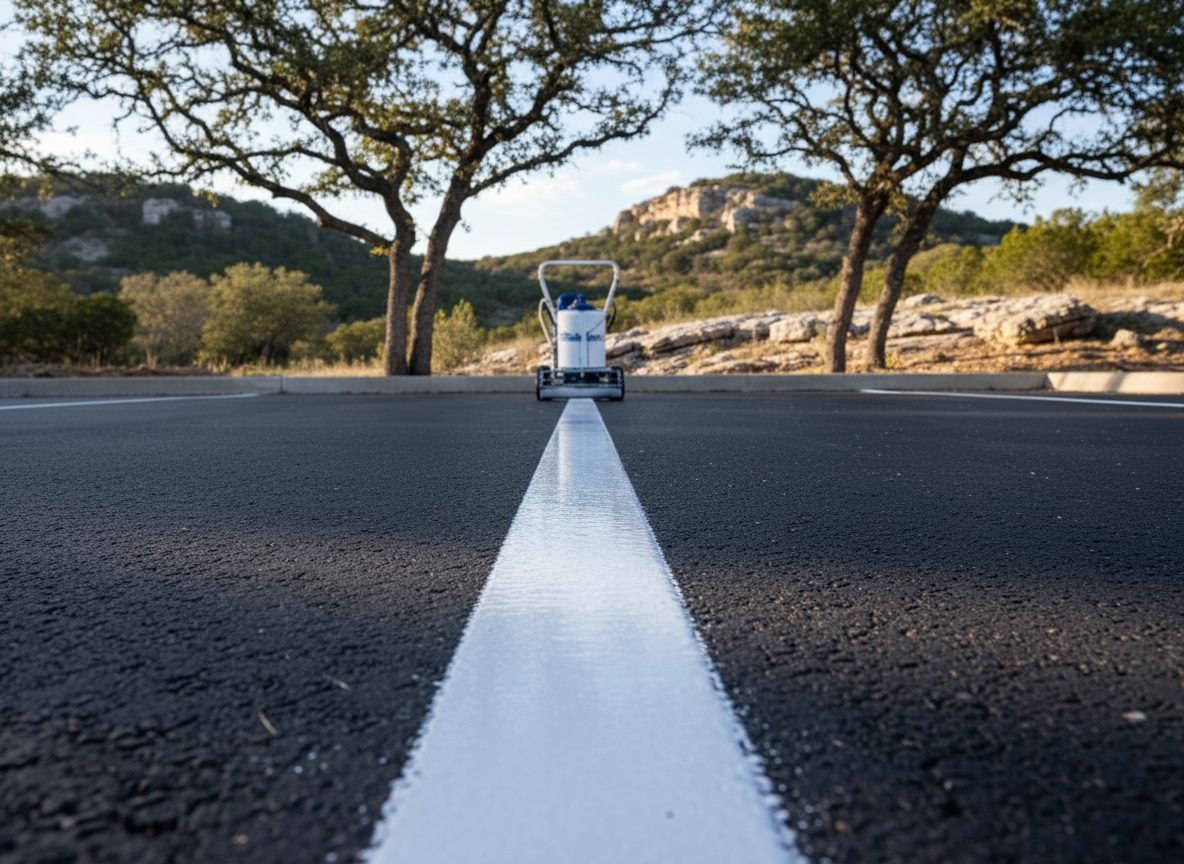
Parking Lot Striping in Georgetown, TX
New layouts and restripes for retail, office, church, school and multifamily lots in Georgetown, Round Rock and across Williamson County.
Get a free estimate
Tell us what the pavement is doing. We call back the same business day.
Parking Lot Striping, done right for Georgetown ground and heat
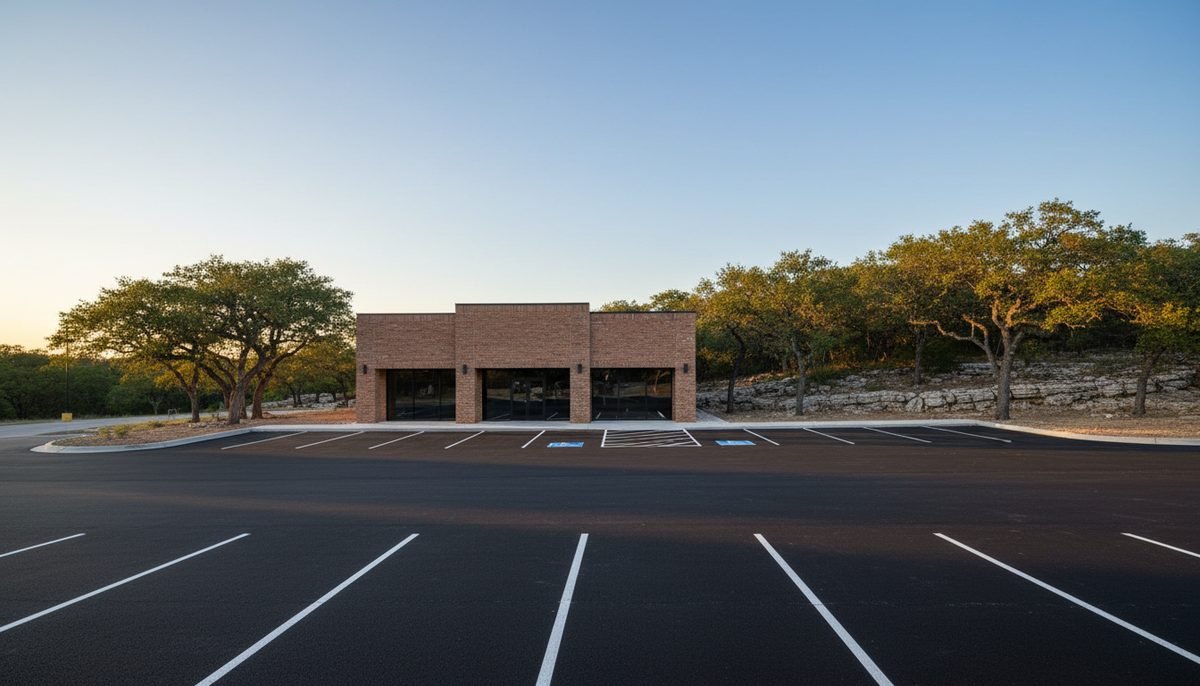
A parking lot with sharp lines parks more cars, in straighter rows, with fewer door dings and fewer arguments about who is in whose spot. A lot with ghost lines does the opposite. Drivers straddle stalls, delivery trucks block aisles, and the accessible spaces disappear into the grey. TXST Paving Company stripes lots across Georgetown and Williamson County, from single tenant buildings on University Avenue to multi-building centers in Wolf Ranch and apartment communities in Round Rock and Hutto.
We do two kinds of striping work as part of our line marking services. A new layout, where we take a bare surface and lay out every stall, aisle and marking from a plan. And a restripe, where we follow the existing pattern and bring it back to full contrast. Both start with a site walk and end with a lot you can open the same afternoon.
All our striping services
- Parking Lot Striping: Crisp new layouts and restripes with traffic grade paint, stencils, arrows and stalls that line up.
- Handicap Space Marking: Accessible and van accessible spaces, access aisles, signage and symbols laid out to ADA and TAS.
- Fire Lane Striping: Red curb and lettered fire lanes that pass the fire marshal the first time.
Parking Lot Striping in Georgetown, explained
 01
New Layout or Restripe: Which One You Need
The decision usually comes down to whether the old lines are worth keeping.
New Layout
We lay out from scratch on new asphalt, after an overlay or resurfacing, or when the owner wants a different pattern. A new layout is the time to fix problems: stalls too narrow for today's trucks, a missing van accessible space, drive aisles that dead end, or angled stalls that waste room on a lot that would hold more cars at 90 degrees. We work from the civil drawing when there is one and from a measured field layout when there is not.
Restripe
If the layout works and the lines are simply faded, we restripe over the existing pattern. The crew snaps a reference line, checks that the old lines are still square, and repaints every stall, arrow, stencil and curb. It is faster and less expensive than a new layout, and on most Georgetown lots it is what we end up doing every 18 to 24 months. If the old lines are badly off or the lot has been patched in several places, we blackout a few sections and relay them so the finished lot looks like one job, not five.
Stall Sizes, Angles and Line Width
There is no single Texas parking stall size. Georgetown's development code sets minimums for new construction, and most owners want a stall that fits the F-150s and Tahoes that fill lots around here. These are the sizes we use most often.
| Stall type | Width | Depth | Where it makes sense |
|---|---|---|---|
| Standard 90 degree | 9 ft | 18 ft | Retail, office, church, most lots |
| Tight standard | 8.5 ft | 18 ft | Employee lots, long term parking |
| Compact | 8 ft | 16 ft | Only where the plan allows a compact percentage |
| Angled 60 degree | 9 ft | 19 to 20 ft along the stall | One-way aisles, narrow lots |
| Accessible car space | 8 ft plus 5 ft aisle | 18 ft | Required count per lot size |
| Van accessible space | 11 ft plus 5 ft aisle, or 8 ft plus 8 ft aisle | 18 ft | One per six accessible spaces |
Drive aisles need about 24 feet for two-way traffic at 90 degree stalls and less for one-way angled layouts. Lines are 4 inches wide as standard. We paint single lines on most lots and double lines or hairpins where the owner wants drivers to center up. Accessible layouts are covered on our handicap space marking page, since the rules there are strict.
Traffic Paint vs Thermoplastic in Texas Heat
The material decision matters more here than in a milder climate. Pavement surface temperatures in a Georgetown July run 140 to 160 degrees, and UV chews through paint resin fast.
| Factor | Waterborne traffic paint | Thermoplastic |
|---|---|---|
| How it goes on | Sprayed cold through a striping machine, about 15 mil wet | Melted and extruded or sprayed hot, 60 to 125 mil |
| Dry time | Minutes in summer, under an hour in winter | Cools hard in a few minutes |
| Expected life on a busy lot | 12 to 24 months | 3 to 6 years |
| Cost | Lowest | Several times more per foot |
| Best uses | Stall lines, restripes, sealcoat refreshes | Entrances, stop bars, crosswalks, arrows, drive-thru lanes |
| Weak point | Fades under UV and tire scrub | Can chip on cracked or oxidized asphalt |
Our usual recommendation on a Georgetown retail or office lot is a hybrid: waterborne paint for stall lines, which are cheap to refresh, and thermoplastic where tires turn and stop. On a fresh sealcoat we use paint only, since thermoplastic needs a fully cured, clean surface to bond. On concrete lots, common on newer commercial pads along Ronald Reagan Blvd and in Leander, we use a paint formulated for concrete or an epoxy so it does not peel.
Arrows, Stencils and Curb Painting
Stall lines are only half of the job. A lot works because of everything else painted on it.
Stencils go on with the same traffic paint or thermoplastic as the lines. Curbs get a coat of curb paint after a wire brush and blow off. On rough or spalled concrete curbs we repair first, see curb and gutter repair.
How Often to Restripe Under the Texas Sun
It depends on traffic, material and how dark the pavement is. Here is what we see on Central Texas lots.
The single best way to stretch the cycle is to keep the asphalt dark. A sealcoat every 3 to 4 years, with fresh lines on top each time, keeps the lot looking new and protects the surface from oxidation. Our parking lot maintenance page walks through the full cycle. And on the clay east of I-35, around Westinghouse Road and out toward Hutto and Taylor, we fill cracks before striping, because a stall line painted across an open crack is broken the next time the clay moves.
How We Stripe a Lot
From first call to finished surface
No mystery and no pressure. You know the scope and the price before a single truck shows up.
Call or text
Reach us at (737) 403-8619 and tell us what you have, a driveway, a parking lot or a private road.
On site measurement
We walk the pavement, measure it, check drainage and base condition and take photos of the problem areas.
Written estimate
You get a clear written estimate with options, usually within a day or two of the visit, free of charge.
The work
Our crew shows up when scheduled, does the job, explains cure times and leaves the site clean.
“As a Realtor serving the Georgetown area, I'm careful about recommending local companies to my clients. TXST Paving has consistently been responsive, professional, and dependable, making the entire process straightforward from the initial conversation through completion.”
“I recently used TXST Paving Company for patching and sealing my driveway. They did a really good job. It makes my customers feel safe getting into my shop. Thank you to the team for working hard even on the holiday!”
“I've used Texas State Paving for the last several years, and each time expectations were met. Great company!”
Parking Lot Striping in Georgetown: your questions answered
How soon can you stripe new asphalt?
We like to wait about 30 days after new asphalt is laid. Fresh hot mix keeps releasing oils as it cures, and paint applied too early can sink in, discolor or peel. If a tenant has to open sooner, we can lay temporary markings and come back for the permanent striping once the surface has cured, which we plan into the schedule up front.
Can you restripe a lot that was just sealcoated?
Yes, and that is the ideal time to do it. In Georgetown summer heat the sealcoat is usually cured enough for traffic paint in 24 to 48 hours. We hold off on thermoplastic until the sealcoat has fully hardened, since it needs a clean, cured surface to bond. When we do both, we schedule the striping return trip as part of the job.
Do you match my old layout exactly?
On a restripe, yes, unless something in the old layout is wrong. If the accessible space count is short, a van space is missing, or the stalls are narrower than the plan calls for, we tell you before we paint and show you the fix. Most owners want the same layout back, cleaner, and that is what a restripe delivers.
What color should my stall lines be?
White is the standard for stall lines on asphalt in Texas, with yellow used for no parking zones, loading areas, curbs and some edge lines. Blue is reserved for accessible spaces and aisles, and red for fire lanes. On concrete lots we often paint yellow or blue stall lines for contrast, since white disappears on light grey concrete.
How long will the lot be closed?
Usually it is not fully closed at all. We cone off sections, stripe them, and move on once the paint is dry to the touch, which takes minutes in warm weather. A typical strip center lot is finished in a day. Larger lots are staged over two or more days by section so customers always have somewhere to park.
Work that pairs well with parking lot striping
 01
Handicap Space Marking
Accessible and van accessible spaces, access aisles, signage and symbols laid out to ADA and TAS.
Learn more 02
Fire Lane Striping
Red curb and lettered fire lanes that pass the fire marshal the first time.
Learn more03Asphalt Paving
New hot mix asphalt for driveways, lots and private roads, built on compacted base that handles Williamson County clay.
Learn more
Want a straight answer on parking lot striping?
Call or text and we will come out, measure and put a fair price in writing.